So, you're trying to get your dispensary to rank at the top of Google and you've gotten so much information at this point that it's basically information overload. So, the purpose of this video is to really simplify all of that information down to three major things that you should pay attention to. Just three, but these are the three major factors that Google takes into account when ranking for local SEO. You cannot and will not rank without taking these three things into account. And it's basically the 8020 rule, right? Let's focus on the things that actually matter. Without any further ado, let's dive right into the video. So, the first thing that matters is distance. Distance is always going to matter. Proximity is always going to matter in the phrase local SEO is the word local, right? So, Google wants to show searchers local businesses that are local to their area.
So, the obvious, of course, if you're a dispensary in Los Angeles and somebody in New York is searching for dispensaries near them, you are not going to pop up in the search results, [snorts] right? That's the obvious. But the other thing is proximity matters in even closer ranges than you might think. So, for example, if you're a dispensary in Santa Monica, which is a city in the county of Los Angeles, and you want to rank, you want to show up at the top when somebody searches dispensary Los Angeles, right? It's going to be an uphill battle. Google is much more likely to show dispensaries that are closer to the city center of of Los Angeles than they are to show a dispensary 10 or 20 m away. So, you have to take that into account. You might want to just try to rank for keywords that are closer to your area. So, dispensary Santa Monica, dispensary Venice, dispensary Westwood, right?
Those are all cities in or around your area and you're going to have a much higher chance of ranking for those keywords. The other thing is service area businesses. So, in California, we have a type 9 deliveryonly license where they have a warehouse that they deliver out of, but they are not open to the public. And if you have one of those businesses, you might be tempted to hide your address from your Google business profile. Well, that's going to be an uphill battle for you, too, because then Google doesn't know where you are locally, and Google can't send local searches to your business, right? So, Google recently changed their rules around this. They make it much, much harder to rank for local SEO if you're not displaying your address. So, if you're a type 9 license and you only do delivery, you still should display your address and try to rank for keywords in or around your location. I know sometimes this is completely out of your control, but I've seen businesses go as far as literally registering offices in certain areas, like, you know, buying offices, paying for the the lease on the office just so they could get a Google business profile closer to the area that you're that they're trying to target, right? So, it's that important. It's that critical. You can't fake your way around it. You have to be as close to the location of that keyword search to rank for that keyword. Right? So that's distance. That's proximity. That's number one. The next thing is relevance.
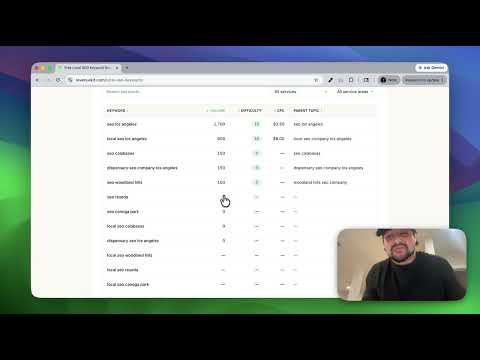
So this is number two. Okay? You're in their area, right? Somebody's searching in Santa Monica. You're a dispensary in Santa Monica. But if they search for barber shop Santa Monica, of course, your business is not going to pop up. you're not relevant to that person's search term, right? So, we want to make sure that your business is as relevant as possible. You're not trying to rank for search terms that are not actually what your business does or what it sells. And the first step of this is keyword research, right? So, I already talked about, you know, if you are in Santa Monica, you might want to rank for dispensary Santa Monica, dispensary Venice, dispensary Westwood, cities in or around your area. But there's a way that you can see how well you're ranking for those keywords today. So there's a completely free tool. Uh I built this myself. This is on revenuekit.com.
If you go to revenuekit.com and you click on SEO audit free tool, you can actually use this to search for your business listing and then see what keywords you're ranking for. So let's just go through this really quick. Let's say I search for um here, let's pick one of these guys. Let's do Hi in Northridge dispensary. So, first thing you're going to do is um search for your Google business profile and you're going to select that under business name. Uh the address of this business is actually Los Angeles. So, the first two keywords we're going to fill out for you. It's always going to be dispensary near me and then it's going to be dispensary in the city of your address, right? In your business name. And then you could also do, let's say they want to try to rank for best dispensary in Northridge. The third keyword you could fill out yourself.
We're going to click continue. We're going to fill out our information and start the audit. What this is going to do is it's going to scan your Google business profile. It's going to pretend that it's a consumer in your area searching for those keywords and it's going to give you an exact audit of how your business ranks currently. So, let's give this a second to run and I'll see you guys in a second where we could see the results.
All right. And the results are in. Uh, basically, you just click on these three links and it will open a scan report for each link. So, let's take a look at dispensary near me. Right? If somebody searches for dispensary near me, this is how the search results look. So what this software does is it pretends to be a consumer in each one of these dots, right? So they literally do a search in this area, a search in this area, a search in this area, and they see where this business ranks in that area. So, you can actually see for uh dispensary near me, if somebody searches in these areas, if they're here, this dispensary does rank number one, right? And I'm not far from this area, which is why I'm seeing them as uh number two, right?
When I search for dispensary Northridge, uh but if you go a little left, they're number nine. You go further away, they're 15, right? Further away, they're 20 plus, right? So, this gives you a good idea for that keyword. Where does your dispensary show up in local search and what areas you need to work on? Let's take a look at dispensary Los Angeles. So, this dispensary is not in Los Angeles again, right? They are in Northridge, a city in Los Angeles County. Um, they do show up if you are very close to that dispensary, but they fall off very quickly away, right? So, the proximity really kicks in here. If you are in that uh near that dispensary and you search uh for dispensary Los Angeles, they will still show up. But again, you go a little further away, a little further away, all of all of a sudden the proximity kicks in and they are irrelevant. They don't show up at all. The last thing is for best dispensary Northridge. So, this is where they seem to do the best. Right? If you search best dispensary Northridge and even in a widespread area, they are showing up second or third place. So, they're doing really well for that keyword specifically. So, do your keyword research, see what your competitors are ranking for, see the keywords that you want to rank for and where you stand. You could run this report again for free on revenuekit.com.
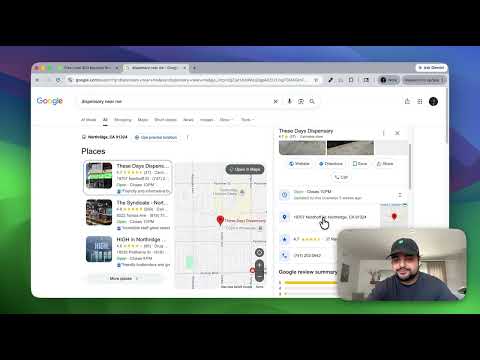
The other thing is if you want to see where Google wants you to be for proximity's sake, a good way to do it is just search the keyword. So if you search dispensary Santa Monica for example, Google is literally showing you the area that they expect you to be in, right? So by default, if I don't move any of this around, right, I just search dispensary Santa Monica. I click enter. By default, that little box, that square is the section that they're looking at.
So if your dispensary is within that limit, you have a great chance of ranking for that keyword. If you are not in this box, your chances fall off the further away that you get. Cool. I hope all that makes sense. Uh that's keyword research. You know, that's proximity. We talked about some other things that you can do to make sure that you're relevant to the consumer search is optimize your business description. So, you know, Google's literally asking you, they're giving you a place to type out your description. They're asking you, "What do you do? What areas do you service?
Who do you service?" They're going to take that into account where people when people search for keywords, whatever keywords that you want to rank for, make sure that you mention those repeatedly in your business description. That's just an easy one. It's a set it and forget it. And then lastly, your category as well. Another easy one. Of course, if you're categorized as a barber shop on Google, you are not going to or if you're categorized as a dispensary on Google, you're not going to pop up when somebody searches barber shop near me. But there's also adjacent categories, right? So, some people put themselves as like a smoke shop or a drugstore or a CBD store. Uh, you know, just again, depending on the keywords that you're going for, the category you're in could make or break that. So again, an easy thing to do is just search the keyword that you're trying to rank for and see what category people have selected, what's working for them.
In this case for dispensary Santa Monica, cannabis store, the top three, they're all using the cannabis store category. So chances are you want to use that category as well if you're targeting that keyword. And that is relevance. Okay, so that's number two. You are close to the consumer. You're also now relevant to their search term. They're searching dispensary Santa Monica. You're in Santa Monica. You have dispensary Santa Monica keywords in your description and uh you're targeting it intentionally and you have cannabis store in your category. So far, you're set up for success. The next thing we want to look into is prominence. So, this is the last thing. So, how prominent is your business? How much authority does your business have? And the way Google looks at this is primarily broken down into citations and reviews. So what a citation is is where is your business listed, right? So let's say you have a Google business profile, but you're not listed on Yelp, you're not on Facebook, you're not on Forsquare, you're not on Weed Maps, you're not on Leafly. How confident is Google going to be to rank you at the top and show you as a result when somebody searches Dispensary Santa Monica, right? Their confidence is tanking. So in contrast, let's say there's a business that is targeting the same keywords as you, but they're listed everywhere. They have a wide reach across the internet. Google looks at all these things to build prominence and to make sure you're a business that people can trust and they can trust ranking you at the top as well. So you want to build out your citations as many as you can on Yelp, on Google, Facebook, industry specific ones such as Weed Maps and Leafly. Literally as many as you can.
The more citations the better. And you want to make sure that you have NAP consistency, right? So all NAP consistency is, it sounds fancy, is just your name, that's N, your address, that's A, and phone number, that's P. So you want to make sure wherever you're listed, if you're on Yelp, if you're on Weed Maps, the name of the business matches, the address of the business matches, and the phone number matches. Why? Again, just for credibility, for consistency, for trust. Imagine if you're on Google Business and you're saying your address is one thing, but your address on Yelp is something different and your address on Weed Maps is something different and leafy it's something different. Again, you're less credible, you're less trustworthy, uh, and Google is going to demote you as a as a matter of that, right? So, they want to make sure you're a real business, you exist at that address that you're telling Google you exist, your phone number is accurate, and that NAP consistency helps when you're building citations.
Lastly, we have reviews. So, reviews, you know, they're critical. It's a critical trust signal, not just for Google, but obviously anybody else, right? If I'm looking for restaurants in my area and a sushi restaurant has a,000 fivestar reviews and a different sushi spot has 20 twostar reviews, I'm much more likely just as a consumer to go with a higher rated one. But of course, Google takes it into account as well. So you want to have more reviews than your competitors, more positive reviews as your competitors, and you want to be getting reviews often. So how do you do that? You can also use a tool at revenuekit. So again, it's revenuekit.com.
Just sign up for a free demo. We have a tool that does exactly this. The way we do it is we integrate with your cannabis point of sales system and we will text every single customer after they're done placing an order and we basically ask them to leave a review and we encourage them to leave a positive one. So this is an example of how your review profile can look. You can customize it with your logo, your colors, um your branding of course. And this is how we this is what we text the consumer and this is how we ask them to leave a review. Uh so every consumer is going to get this automatically through text. We can also generate full-sized flyers for you. So again, with your branding, your colors, your logo, you could print this and you could put it by your cash register where consumers can scan it the code, the QR code, and leave a review. Will also generate half-sized flyers for you. So, you can print these out and put them in with every order, right? As many touch points as you can. The goal is to get every single consumer to leave a review.
That way, you're building your reviews. You're getting a ton of them. Um, you know, they're positive reviews and you're getting them often. That is helping you build your prominence with Google. That's it. Those are the three factors. Take action today. See what keywords you want to rank for. See the proximity of where you want to rank and make sure your business is as prominent as possible with those citations, with those reviews. Honestly, that's going to get you about 80 90% of the way. So, if you want three things to focus on and three things alone, that's where you focus. That's it for this video. If you have any comments, questions, feedback, uh leave a comment below. Let me know how I could help. Until next time, peace.